Home > Thematics > Cultural Identities
International inspirations
#Australia - #Canada - #France - #Hungary - #India - #Mexico
Australia
Precisely cut from wood, the silhouette of the map of Australia is displayed here in all its simplicity. The choice of a material left in its natural appearance highlights the grain and tonal variations of the wood, giving the piece a warm and authentic character.
At the center of the composition is a metal medallion representing the village of Vignacourt. Engraved inscriptions recall that this work was created for a commemorative event dedicated to the historical ties linking this French commune with Australia.
This creation particularly evokes the presence of Australian soldiers who stayed in the Somme during the World War I. The village preserved the memory of these men through photographs taken on site, bearing witness to the bonds of fraternity and remembrance that still unite Australia and France today.
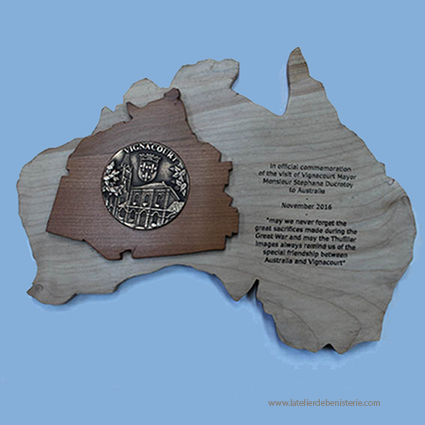
Australia map with French village map inside.
Canada
Created in marquetry, this portrait stands out against a maple leaf–shaped background, whose contrasts of wood and color enhance the craftsmanship of the piece. An emblematic symbol of Canada, the maple leaf holds a central place in the nation’s identity and appears at the heart of the Canadian flag.
The inscription “We remember,” delicately integrated among the daisies, echoes the famous motto of Quebec: “Je me souviens” (“I remember”). This symbolic reference combines memory, tribute, and cultural identity, while reinforcing the emotional significance of the work.
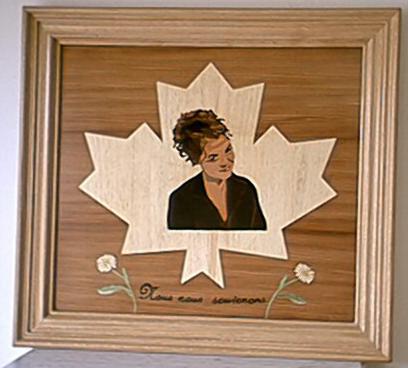
We remember, between the two daisies is a blink of an eye to the motto of Quebec: "I remember";)
Biplane made in marquetry
The top of this bedside table is adorned with a finely depicted biplane, evoking the early days of modern aviation. Emerging at the beginning of the 20th century, biplane designs experienced considerable growth during the World War I, a period in which these aircraft became emblematic of the beginnings of military aviation and the exploits of wartime pilots.
Through its evocative decoration, this piece of furniture pays tribute to the world of aviation and to those who embodied it. Created especially for a Canadian pilot, this work combines historical memory, a passion for aviation, and artisanal craftsmanship, transforming an everyday piece of furniture into an object of remembrance and transmission.
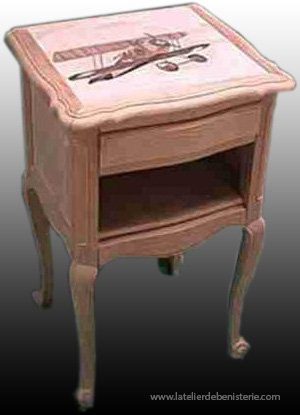
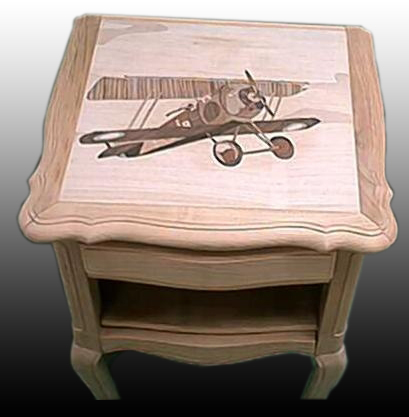
Canadian biplane in marquetry!
France
This marquetry decoration is inspired by the famous Vendéan emblem: the intertwined double heart surmounted by a cross, a symbol deeply rooted in the historical and cultural identity of Vendée. Derived from an ancient tradition whose origins are believed to date back to the Gallo-Roman period, this motif gradually became, over the centuries, a sign of loyalty, attachment, and collective memory.
Finely integrated into the decoration of this wooden game box, the Vendéan heart gives the object a strong regional and symbolic dimension. The marquetry work highlights the elegance of the design while emphasizing the craftsmanship required for its creation.
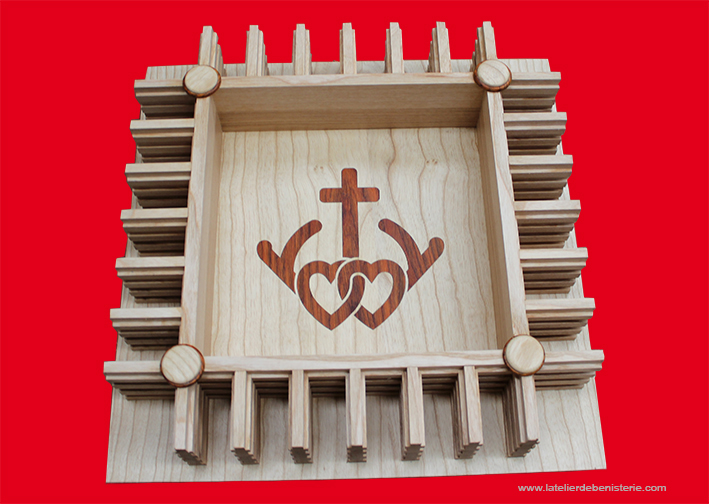
Heart of Vendée on this wooden box - Utrique fidelis.
Hungary
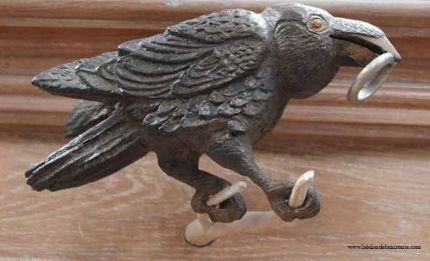
Perched at the top of a tree, the famous “Master Crow” immortalized by Jean de La Fontaine finds here a striking historical and heraldic echo. This crow, carved in wood and holding a ring in its beak, reproduces the emblem featured on the coat of arms of Matthias Corvinus, the 15th-century Hungarian sovereign.
These arms appear notably in the German manuscript of Johannes de Thurocz, where the crow became a true dynastic symbol. According to legend, the bird stole a precious ring before Matthias succeeded in recovering it, transforming the episode into a founding tale associated with his power.
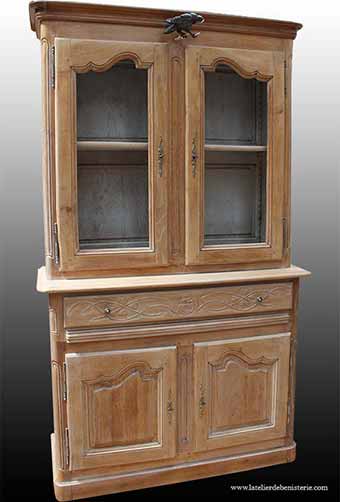
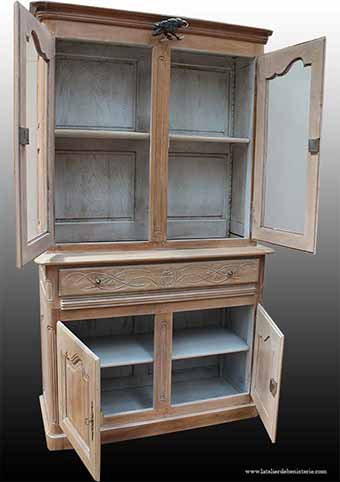
This sculpture was created to be fitted onto the upper section of this two-part cabinet surmounted by a display case. Placed as a crowning element, it gives the ensemble both a decorative and symbolic dimension, recalling the importance of heraldic emblems in the art of furniture making.
India
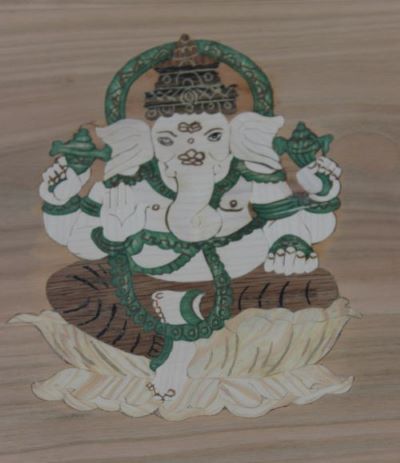
This marquetry depiction of Ganesha forms part of an ornamental design intended to enhance a piece of furniture by placing one of the major figures of Hinduism at its center. Ganesha is indeed one of the most revered deities in the Hindu pantheon, symbolizing wisdom, prosperity, and the removal of obstacles.
This iconography is rooted in the artistic and religious tradition of Hinduism, whose representations spread far beyond India. Ancient and adapted forms can be found in several regions of South and Southeast Asia, particularly in Cambodia, Myanmar, and Thailand.
These artistic testimonies illustrate the spread of Hindu worship and its reinterpretation over the centuries, as forms, styles, and symbols were integrated into local traditions while preserving the spiritual power of the deity represented.
Mexico
This marquetry tabletop is decorated with motifs inspired by the art and symbolism of the Aztec civilization. Its design notably draws on elements from the famous Sun Stone, a major work in the history of Mexico and a remarkable testament to the cultural refinement of the Mesoamerican peoples.
Carved in the 15th century from an enormous stone block weighing several tons, the original piece is often regarded as an Aztec calendar, although it also possesses a strong cosmological and religious dimension. At its center appears a representation of the Sun God, surrounded by attributes associated with the deities of the Earth and time. The various concentric rings that structure the composition refer to calendrical cycles and to the worldview developed by the Aztecs.
Transposed here into marquetry, these symbols give this table a decorative, historical, and spiritual dimension, while highlighting the graphic richness of pre-Columbian iconography.
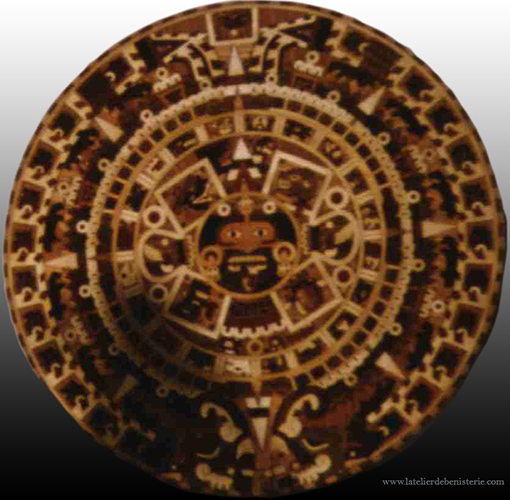
Marquetry tabletop restored.